«
Argentina

Mendoza
Mendoza
Mendoza
Altitude Malbec Headquarters
Welcome to the land where vineyards touch the clouds and breathing gets a little harder. This isn't just about red wine, it's about pushing winemaking to dizzying vertical limits where the air is thin but the flavor is thick.
Welcome to the land where vineyards touch the clouds and breathing gets a little harder. This isn't just about red wine, it's about pushing winemaking to dizzying vertical limits where the air is thin but the flavor is thick.
Welcome to the land where vineyards touch the clouds and breathing gets a little harder. This isn't just about red wine, it's about pushing winemaking to dizzying vertical limits where the air is thin but the flavor is thick.
LEADERS


HELPERS
















Why it's unique
Malbec Superstar
Desert Viticulture
Andes Magic
Think you know Malbec? Not until you've visited its adopted home. While France treated it like a backup singer, Mendoza turned Malbec into the Beyoncé of the wine world. It is the sheer scale of viticulture here, nestled right up against the snow-capped Andes, that makes it unlike anywhere else. You get intense sun, minimal rain, and irrigation straight from melting glaciers. It is extreme desert winemaking at its finest.
Think you know Malbec? Not until you've visited its adopted home. While France treated it like a backup singer, Mendoza turned Malbec into the Beyoncé of the wine world. It is the sheer scale of viticulture here, nestled right up against the snow-capped Andes, that makes it unlike anywhere else. You get intense sun, minimal rain, and irrigation straight from melting glaciers. It is extreme desert winemaking at its finest.
Think you know Malbec? Not until you've visited its adopted home. While France treated it like a backup singer, Mendoza turned Malbec into the Beyoncé of the wine world. It is the sheer scale of viticulture here, nestled right up against the snow-capped Andes, that makes it unlike anywhere else. You get intense sun, minimal rain, and irrigation straight from melting glaciers. It is extreme desert winemaking at its finest.
Terroir
Hot Days
Cold Nights
Rocky Soil
It is all about that massive diurnal shift, friends. Days are baking hot, cooking the berries to ripeness, while nights drop to shivering temperatures, locking in that precious acidity. Malbec loves this stress. The soils are mostly alluvial sand and clay on top of rocks, meaning drainage is excellent. Vines have to dig deep for water, resulting in concentrated, thick-skinned berries that produce color you could paint a car with.
It is all about that massive diurnal shift, friends. Days are baking hot, cooking the berries to ripeness, while nights drop to shivering temperatures, locking in that precious acidity. Malbec loves this stress. The soils are mostly alluvial sand and clay on top of rocks, meaning drainage is excellent. Vines have to dig deep for water, resulting in concentrated, thick-skinned berries that produce color you could paint a car with.
It is all about that massive diurnal shift, friends. Days are baking hot, cooking the berries to ripeness, while nights drop to shivering temperatures, locking in that precious acidity. Malbec loves this stress. The soils are mostly alluvial sand and clay on top of rocks, meaning drainage is excellent. Vines have to dig deep for water, resulting in concentrated, thick-skinned berries that produce color you could paint a car with.
You gotta try
Uco Malbec
Fruity Bonarda
Crisp Chardonnay
Malbec is the obvious captain of this team, specifically those from the Uco Valley which offer floral notes alongside the dark fruit punch. But don't sleep on Bonarda either. Once a bulk wine workhorse, Bonarda has cleaned up its act to become a fruity, medium-bodied delight. If you want a curveball, grab a Chardonnay from high elevations, it has a crispness that cuts through the heat like a laser.
Malbec is the obvious captain of this team, specifically those from the Uco Valley which offer floral notes alongside the dark fruit punch. But don't sleep on Bonarda either. Once a bulk wine workhorse, Bonarda has cleaned up its act to become a fruity, medium-bodied delight. If you want a curveball, grab a Chardonnay from high elevations, it has a crispness that cuts through the heat like a laser.
Malbec is the obvious captain of this team, specifically those from the Uco Valley which offer floral notes alongside the dark fruit punch. But don't sleep on Bonarda either. Once a bulk wine workhorse, Bonarda has cleaned up its act to become a fruity, medium-bodied delight. If you want a curveball, grab a Chardonnay from high elevations, it has a crispness that cuts through the heat like a laser.
LOCAL TALES
The French Reject Finds a Home
The French Reject Finds a Home
The French Reject Finds a Home
Back in 1853, statesman Domingo Sarmiento wanted to improve Argentine agriculture, so he championed the hiring of French agronomist Michel Pouget. Michel packed his bags and brought distinct cuttings, including one that was struggling with mildew back in France. While Malbec was coughing and wheezing in Bordeaux, it arrived in Mendoza and essentially said, "Honey, I'm home." The dry desert air cured its ailments instantly. It flourished so aggressively that even when other vineyards were pulled up during economic crises, Malbec hung on. It went from an immigrant experiment to the national identity, proving that sometimes you just need a change of scenery-and a massive mountain range-to reach your full potential.
Back in 1853, statesman Domingo Sarmiento wanted to improve Argentine agriculture, so he championed the hiring of French agronomist Michel Pouget. Michel packed his bags and brought distinct cuttings, including one that was struggling with mildew back in France. While Malbec was coughing and wheezing in Bordeaux, it arrived in Mendoza and essentially said, "Honey, I'm home." The dry desert air cured its ailments instantly. It flourished so aggressively that even when other vineyards were pulled up during economic crises, Malbec hung on. It went from an immigrant experiment to the national identity, proving that sometimes you just need a change of scenery-and a massive mountain range-to reach your full potential.
Back in 1853, statesman Domingo Sarmiento wanted to improve Argentine agriculture, so he championed the hiring of French agronomist Michel Pouget. Michel packed his bags and brought distinct cuttings, including one that was struggling with mildew back in France. While Malbec was coughing and wheezing in Bordeaux, it arrived in Mendoza and essentially said, "Honey, I'm home." The dry desert air cured its ailments instantly. It flourished so aggressively that even when other vineyards were pulled up during economic crises, Malbec hung on. It went from an immigrant experiment to the national identity, proving that sometimes you just need a change of scenery-and a massive mountain range-to reach your full potential.
Gambling on the Ghost of Frost
Gambling on the Ghost of Frost
Gambling on the Ghost of Frost
For the longest time, everyone thought growing grapes above a certain height was pure madness. Why risk frost? But Nicolas Catena Zapata, inspired by Napa Valley, decided to gamble big in the 1990s. He pushed vineyards higher into the Uco Valley, specifically planting the Adrianna Vineyard at almost 5,000 feet. Locals thought he had lost his mind and was planting a garden for frost. Turns out, the UV radiation there gave Malbec thicker skins and incredible tannins. The wines beat top Bordeaux in blind tastings, and suddenly, the whole world realized that aiming for the sky wasn't crazy - it was genius. Now, everyone is racing to the top.
For the longest time, everyone thought growing grapes above a certain height was pure madness. Why risk frost? But Nicolas Catena Zapata, inspired by Napa Valley, decided to gamble big in the 1990s. He pushed vineyards higher into the Uco Valley, specifically planting the Adrianna Vineyard at almost 5,000 feet. Locals thought he had lost his mind and was planting a garden for frost. Turns out, the UV radiation there gave Malbec thicker skins and incredible tannins. The wines beat top Bordeaux in blind tastings, and suddenly, the whole world realized that aiming for the sky wasn't crazy - it was genius. Now, everyone is racing to the top.
For the longest time, everyone thought growing grapes above a certain height was pure madness. Why risk frost? But Nicolas Catena Zapata, inspired by Napa Valley, decided to gamble big in the 1990s. He pushed vineyards higher into the Uco Valley, specifically planting the Adrianna Vineyard at almost 5,000 feet. Locals thought he had lost his mind and was planting a garden for frost. Turns out, the UV radiation there gave Malbec thicker skins and incredible tannins. The wines beat top Bordeaux in blind tastings, and suddenly, the whole world realized that aiming for the sky wasn't crazy - it was genius. Now, everyone is racing to the top.
The Key Keeper of the Water
The Key Keeper of the Water
The Key Keeper of the Water
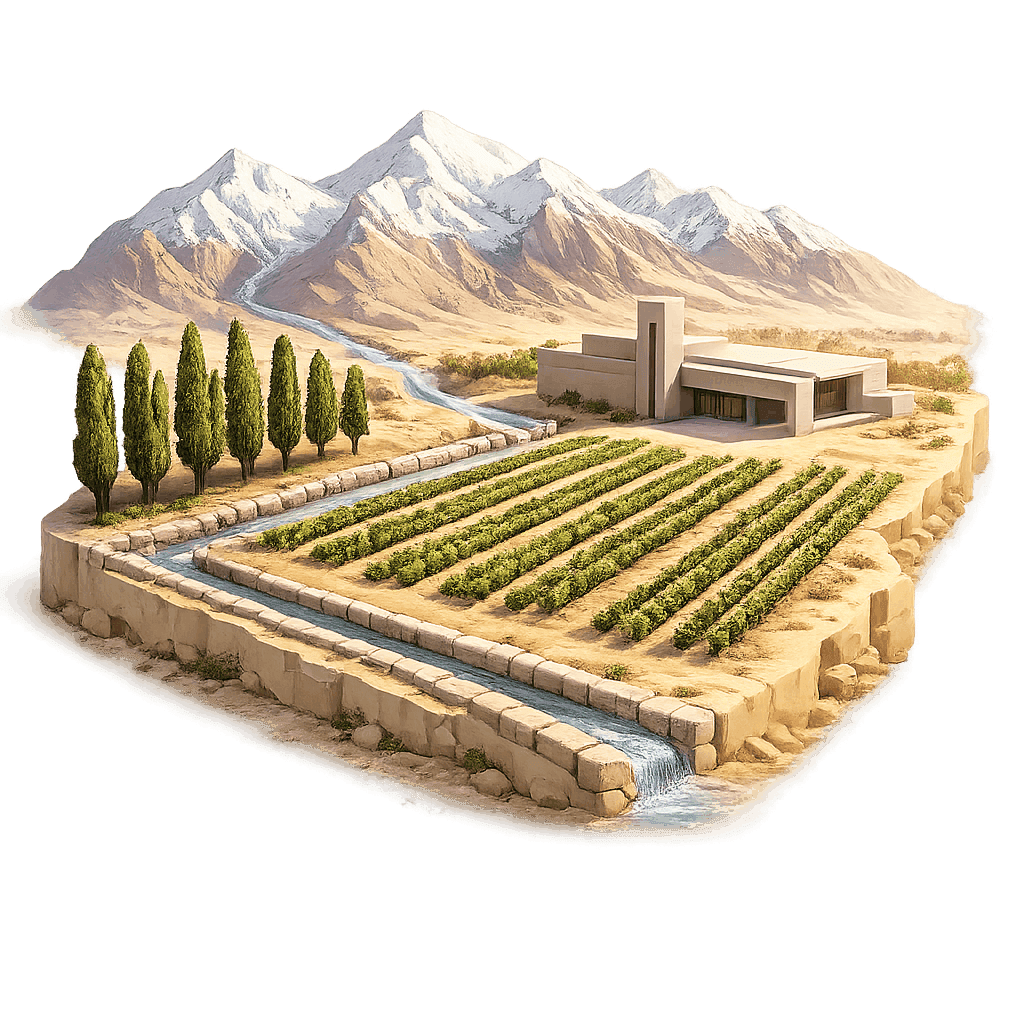
If you walk around Mendoza, you will see deep channels running alongside every street. These aren't for drainage, they are life itself. Known as acequias, this irrigation system was actually developed by the indigenous Huarpe people long before the Spanish arrived. They knew how to harness the meltwater from the Andes snowpack. Today, a figure known as the "Tomero" holds the keys to the water gates, controlling the flow to vineyards with strict precision. It is an ancient, communal plumbing system that turns a dusty desert into a lush green oasis. Without these ditches, your glass would be sadly empty, and the region would just be a very dry pile of rocks.
If you walk around Mendoza, you will see deep channels running alongside every street. These aren't for drainage, they are life itself. Known as acequias, this irrigation system was actually developed by the indigenous Huarpe people long before the Spanish arrived. They knew how to harness the meltwater from the Andes snowpack. Today, a figure known as the "Tomero" holds the keys to the water gates, controlling the flow to vineyards with strict precision. It is an ancient, communal plumbing system that turns a dusty desert into a lush green oasis. Without these ditches, your glass would be sadly empty, and the region would just be a very dry pile of rocks.
If you walk around Mendoza, you will see deep channels running alongside every street. These aren't for drainage, they are life itself. Known as acequias, this irrigation system was actually developed by the indigenous Huarpe people long before the Spanish arrived. They knew how to harness the meltwater from the Andes snowpack. Today, a figure known as the "Tomero" holds the keys to the water gates, controlling the flow to vineyards with strict precision. It is an ancient, communal plumbing system that turns a dusty desert into a lush green oasis. Without these ditches, your glass would be sadly empty, and the region would just be a very dry pile of rocks.
SUB-REGIONS
Luján de Cuyo
(
Mendoza
)
If Mendoza had a VIP lounge, this would be it. Revered as the cradle of Argentine quality, it is where history meets modernity, boasting old vines that have survived everything but an empty glass.
If Mendoza had a VIP lounge, this would be it. Revered as the cradle of Argentine quality, it is where history meets modernity, boasting old vines that have survived everything but an empty glass.
Maipú
(
Mendoza
)
Don't call it a comeback because it never left. This zone is the grandfather of Argentine wine, boasting ancient vines and olive groves that have seen it all. It is pure tradition in a glass.
Don't call it a comeback because it never left. This zone is the grandfather of Argentine wine, boasting ancient vines and olive groves that have seen it all. It is pure tradition in a glass.
LOCAL WINE STYLES
Argentinian Malbec
Imagine climbing a mountain just to jump into a pool of blackberry jam. High-altitude vineyards pump these bottles full of intense fruit flavors and velvety textures that practically scream for a slice of grilled beef.
Imagine climbing a mountain just to jump into a pool of blackberry jam. High-altitude vineyards pump these bottles full of intense fruit flavors and velvety textures that practically scream for a slice of grilled beef.
Imagine climbing a mountain just to jump into a pool of blackberry jam. High-altitude vineyards pump these bottles full of intense fruit flavors and velvety textures that practically scream for a slice of grilled beef.
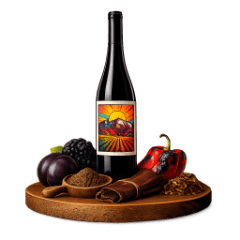
Argentinian Mendoza Red Blend
While Malbec often steals the spotlight, these concoctions prove that teamwork makes the dream work. Winemakers mix Cabernet Sauvignon, Petit Verdot, and Cabernet Franc to create a symphony that is louder, bolder, and arguably more complex than the soloist.
While Malbec often steals the spotlight, these concoctions prove that teamwork makes the dream work. Winemakers mix Cabernet Sauvignon, Petit Verdot, and Cabernet Franc to create a symphony that is louder, bolder, and arguably more complex than the soloist.
While Malbec often steals the spotlight, these concoctions prove that teamwork makes the dream work. Winemakers mix Cabernet Sauvignon, Petit Verdot, and Cabernet Franc to create a symphony that is louder, bolder, and arguably more complex than the soloist.
LATEST REVIEWS